
SHOCK ABSORPTION
The physics of falling apart and finding form again

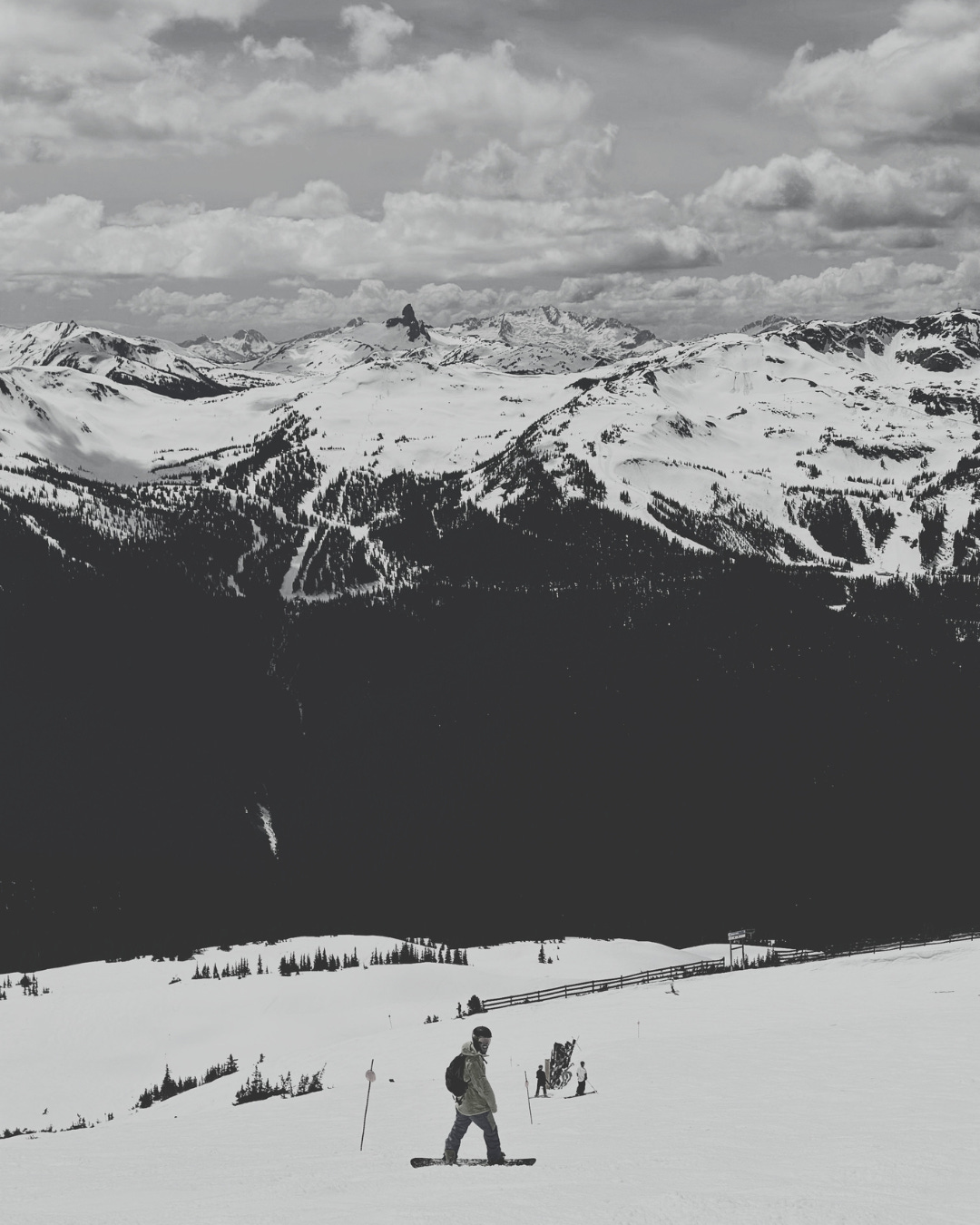
Two years ago I watched my husband scorpion on his snowboard in 7th Heaven at Whistler.
I remember time collapsing into the eternal second as if reality teetered on the threshold of what had just been to what it was about to become, suspended in indecision for which way it would tumble back into time as we know it.
I was downhill from his fall but in seconds, I had overcome being strapped to a board in layers of snow clothes and scrambled up the hard packed snow to meet him.
What I remember first is that he was conscious and I couldn’t see any obvious signs of blood. He looked at me with huge, wild eyes and asked me where his phone was, as if this were the primary concern of the moment, slammed back into the hard mountainside we were sprawled across.
Once we located it, he insisted on getting up. My brain couldn’t process what my eyes had surely and clearly seen, but I wasn’t eager to interfere, indeed, I was afraid to touch him.
He was in shock. He managed to flat board to the chair lift, an effort which likely caused him the final ounces of his energetic capacity, and upon completion, he was promptly taken up by a ski patrol sled to the emergency hospital where he was placed on a spinal board.
After an afternoon of careful examination, we were congratulated by that the lifesaving grace of his Smith Mips helmet, this shocking experience would conclude as nothing more severe than a very bad shake up and a fateful evasion of what might have certainly been a life-altering injury.
Although the physical shock of his accident dissipated rather quickly, the psychological shock lingered almost two years.
Smith Mips helmets feature a technology called Koroyd: a co-polymer core structure designed to crush immediately and uniformly on impact. By deforming in this way, it absorbs force and reduces the peak acceleration transferred to the brain and spine. The helmet was crushed in the process because it successfully absorbed the shock exactly as it was designed to do.
My husband’s ability to absorb the shock of his own near-death experience was a much longer process as his entire body and nervous system needed to learn to slowly uncoil from its reflexive tightening and release the protective bracing.
It was a frustrating two years for him but we kept snowboarding. He regressed and retracted, often returning early and under such exhaustion from the energetic toll of basic effort. In that time, he often expressed his fear that he would never get over it and his discouragement that it was taking so long to recover.
Then one day, he was back and all his old ability returned with a new wave of enthusiasm, not only for the sport he so loved, but also for his capacity to enjoy it now with a reverence for what it really meant to be there.
The First Law of Thermodynamics is that energy cannot be created or destroyed, only transferred or converted from one form to another.
In life, shock and impact is not only guaranteed, but it is inevitable. When this happens, the body receives it first. The nervous system begins absorbing impact long before the mind can name any meaning for it.
The energy of these impacts cannot be destroyed, but it also cannot stay in its original form. The dissipation and transformation of this energy is not a matter of if it happens, but rather of what? What will become of it and what will it become? The way that we absorb the great shocks of our lives determines the texture, the lens, the lived experience of how we relate not just to our pain, nor even to ourselves, but truly as a whole to our entire world.
For some people, the pain transforms into art, others into wisdom, some into strength, and still many more into numbness, shattering, and dissolution.
In Buddhism, the first noble truth is often quoted as “Life is suffering.”
The word Dukkha is more accurately positioned to say that existence is characterized by fundamental instability, that nothing holds its position permanently.
The Buddha shares a parable of Two Arrows, meant to distinguish between unavoidable pain (the first arrow) and self-inflicted suffering (the second arrow). The first arrow is an unavoidable misfortune, while the second is our emotional reaction to it.
Everything will change. The question then becomes what is ours to change, and how will we change it or change with it?
Life is suffering; our job is to make our suffering beautiful, lest we allow it to turn ugly.
My favorite author, Dostoevsky has a famous quote which I think of often, “There is only one thing that I dread: not to be worthy of my sufferings.”
Which to me serves as an invitation to treat pain as an opportunity for growth and to face hardship with dignity, courage, and purpose, rather than despair or bitterness.
The Stoics had a similar desire for equanimity, which is not practically the neat image of calmness and composure, but rather the condition of being undisturbed by things that don’t warrant disturbance.
There is a deep misunderstanding of the stoicism of those who ‘suffer in silence.’ The great masters of our lore are not unmoved by lack of feeling, as if to suggest an absence or separation from it, but rather a silence on speaking to their experience of suffering as a mark of wisdom in knowing the power of our words and attention to create reality.
The transformation of a great impact into something that eventually relinquishes its claim to power over us is first met with correctly assessing what deserves to move us, to what lengths, and for how long.
Simply put, we decide not only what matters, but what to make of what matters. Only so much is within our control; your opinions, impulses, desires, aversions, reactions, perceptions, and so forth.
Much is not; the fact that you will die, your reputation, much of timing and outcomes, and onward.
The dichotomy of control suggests that life falls neatly into two buckets of control: within or without.
But life isn’t binary. It lives in the middle ground where your choices, your discipline, your effort partially shape outcomes without determining them. The middle ground where our human agency actually lives.
This is shock absorption.
We cannot prevent the impending forces of life, indeed we all face the same inevitable ending. But as the comets of impact loom and threaten, we can do our best to direct them, and when they do make contact, to transform them into something that serves us instead of splinters us.
A good life is not one without shock, as certainly a life without friction becomes exceedingly vulnerable and fragile, but one with a well-designed system for shock absorption, layered, receptive, able to respond.
Here’s what I think that looks like…
Nietzsche once famously wrote, “What doesn’t kill me, makes me stronger.” Often applied as a powerful motivational slogan for virtuosity or endurance in the heart of adversity and suffering.
It is an admirable ambition to strive for growth and resilience when confronted with pain. Yet the reality is that it’s not in everyone’s nature to be transformed by the unforgiving forces of life in a positive way. Many are left damaged, weakened, or broken instead.
What is very true is that we as humans have enormous range to be strong in some experiences and completely decimated in others, but our society, culture, and psyche alike are not keen to admit this paradox. Some are strengthened, some are broken, many are both, not only in the same lifetime, but even in the same year.
The gap in between is where enormous damage gets done because we have engrained a set of expectations onto our subconscious that strength is the only acceptable outcome of suffering. What is worse still is the unspoken anticipation for when this alchemy is called to its required completion and a certain return to self is sought.
We call it resilience. We applaud the perseverance, but we never talk about the cost.
The cost is something we practice on each other constantly, and almost always with the best of intentions. I noticed this recently in the most ordinary way.
We recently helped my grandmum move. For the occasion, my aunt baked some cupcakes for the new neighbors as a gesture of welcoming. My aunt is a fantastic baker and an even better artist. Her baking doesn’t just taste incredible, but it is also aesthetically precise and carefully considered in its presentation, a signature of the love she’s poured in.
In the bustle of moving, the cupcakes sat neglected in the elements all day. When we finally noticed them, the icing was slumped around disproportionately and the effect of their effort was greatly altered. Naturally, my aunt was upset, and naturally, we all rushed to assure her that no one cared and that it had no effect on the way they tasted.
Even subconsciously, we would be apt to acknowledge that this is not true. We love beautiful things, we enjoy them more, they factually taste better when we anticipate them to taste good because we can see how good they look. The overall impression of her cupcakes was diminished as was the full realization of her expression of love. It was not able to be fully seen, appreciated, or received the way it was intended.
What might have been a more loving response from us was a moment of allowing. The space where the energy shifts from one form to the next is often rushed or squashed in the immediacy of an explanation or resolve. But the body absorbs impact first. We need space to allow the flow of feeling to release it so that we might see it outside of ourselves, from a distance large enough to give us the correct perspective to decide what to do with it.
This example is a relatively trivial example of the simple ways in which we impose our collective expectations upon one other, insisting that people bear the impact exactly as we expect them to. It dissolves space for authenticity or even personalized growth as we funnel each other through the ‘stages of grief’ we’ve deemed appropriate for the terms.
This is not abstract to me.
A few years after my dad died, my first boyfriend broke up with me. I was 16. Hormonal changes aside, I was outwardly more devastated for the loss of a relationship than from the loss of a life. I remember my mum being very mad at this contrast. But to me, it seemed obvious.
One was acute and immediate in a context that I could navigate and understand. My heart was broken from the pain of unrequited love. I could easily find my orientation in a break-up. I was now an ex-lover.
But the vast implication of being without my dad was too broad and its consequences too layered, for me to begin to understand the complexity of the wounds as they would come to emerge and re-emerge across different contexts and environments, as someone navigating how to move through the world as a girl without a dad.
When I was 18 and graduation loomed, the reality of all the firsts that would come to pass in my life without a father began to agitate my psyche. I’ll never forget the school bully, so keen to ask, “Shouldn’t you be over it by now?” As if the expectation to just spring back to the threshold of puberty, with all its innocent ideals intact, were an obvious default, and my inability to do so a kind of deliberate rebellion.
The unspoken social layer is that we don’t just expect resilience, but we actually celebrate the speed of resilience as much as its conclusion. This is the quiet impatience and subtle intolerance that divides us not only from those we love and the world, but most dangerously, from ourselves.
Just last year, my mum herself alluded to the fact that “we’ve moved on from that.” Truthfully, I’m not sure that I will ever be ‘over it’ or fully moved on, nor that I want to be. True, I’ve chosen not to be shaped or defined by it, but there is a real and tangible loss which I do not feel the need to transform into anything other than what it is: a significant impact in my life that left a little dent. And I’m okay with that.
For a long time though, and sometimes even still, I hesitate on these wounds with an erosive feeling inside that I do well enough to slough off quickly and thoroughly, lest it claim any space of its own within me.
A failure to perform or a push against the cultural patience of what is considered a ‘normal’ and acceptable reaction introduces quiet judgment and withdrawal that internalizes something far more toxic: shame.
Shame is the gap between who we are and who we believe we are supposed to be. Who the world wants us to be. Who we think we need to be in order to belong, to be accepted, to be loved.
Shame is the Buddha’s second arrow that convinces us that the reason you are not yet restored is because something is wrong with you.
Not that the load was too great; not that the recovery time is appropriate to the impact, particularly given the landscape of skills and tools available; not that the cellular structure was genuinely destroyed and what comes from that takes time, resources, and intention to rebuild.
Shame is the voice that says YOU, specifically, are the problem.
And truthfully, you might be.
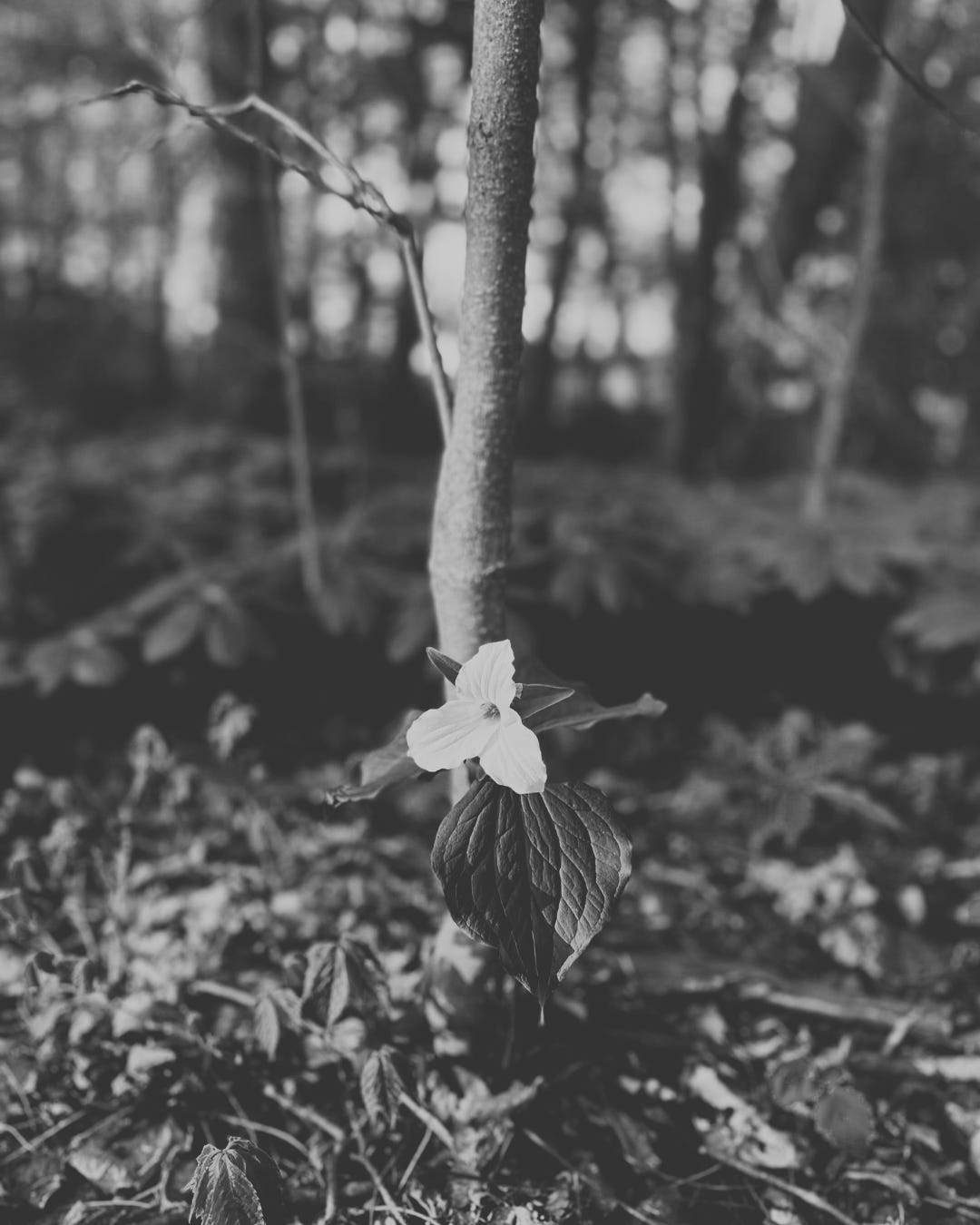
A flower potted and a flower in the wild are both equally beautiful, but they are destined for two very different lives.
My favorite line from Pink Floyd’s iconic song, Wish You Were Here is “Did you exchange a walk-on part in the war for a lead role in a cage?”
To me, this line asks whether you traded an authentic presence in the world, even a dangerous, marginal one, for a comfortable but imprisoning performance of life.
It’s a question about the seduction of containment; how suffering, when it becomes familiar or something we’ve gotten used to and accepted, can convert from something that happened to you into the walls you live inside.
Some people are so addicted to their suffering that they make it their entire identity.
Living within the limitations of their labels and siphoning their whole life force to maintain a victim story. The cage is reinforced by every retelling of the story, encouraged by an identity built around the wound, and bound by every refusal, conscious or not, to let the energy move through and become something else.
Such people were impacted, no doubt, in a way that overwhelmed their belief that they might have the capacity to overcome it. Not only have they been broken by it, but they have become it; dissolved into and seemingly inseparable from it.
Through this lens, how we fail becomes perhaps of more importance than how we succeed over the great impacts of our lives.
The period of deformation is crucial. In this space, a new orientation toward oneself and the truth about it now, after impact is delicate. It is an opportunity for reformation, to absorb what has happened and reshape it into something better, stronger, more resilient, more robust - if we want to.
But here’s the thing we get wrong in our modern lives: Absorption requires rest.
This is a direct rebuttal to the always-on, high-performance “ideal” that society has raised us on. We are mistaken to forget that our capacity to handle impact is not fixed but rather it is cyclically renewed, or increasingly depleted.
In mechanical engineering, springs deform under load. Their strength is in their rigid and steadfast commitment to a certain form. When they are struck impact they bounce back.
Human identity is much like a spring. It is the part of you that knows who you are beneath what happened to you; the capacity to recall your own shape regardless of the force felt. The error occurs after impact in striving to attain similar composure to the spring, but is this true groundedness or is it a refusal to grow?
A dashpot, on the other hand, resists motion proportional to speed, where the rate of change matters as much as the magnitude. A dashpot can bleed excess energy off slowly as heat rather than sending it back as an endless oscillation.
As humans, we are capable of absorbing enormous change if it happens gradually, but change that happens suddenly and fast can often shatter us. In an idealized expression, we have the capacity to let go and to process the impact effectively.
The spring and the dashpot together are able to absorb impact quite differently than they do alone. They neither oscillate nor shatter, but produce a system that absorbs a shock, returns toward its original form, and settles.
This is the difference between someone who has been through difficulty and integrated it versus someone who either never recovers their sense of self or someone still bouncing between the same two states years later.
This is psychological maturity: remembering who you are and being able to let go of what no longer serves you.
And part of where we get stuck is that impulse, change in momentum, is force multiplied by time. More practically, that means a small force over a long time produces the same impulse as a large force over a short time.
There is the same total effect on the system, but a totally different experience of it.
We have emergency plans for what is fast and sudden. We built a world equipped with seat belts, airbags, emergency rooms, crisis hotlines, first responders and fire departments.
We have culturally agreed upon timelines for acute impact. We factored in bereavement leave, insurance claims, disaster relief, trauma counseling.
We know what to do when the shock is obvious.
But we have almost no framework for the slow accumulation and it’s impact over time.
There are forces small enough to go unrecognized in the day-to-day but consistent enough to compound. The fatigue loading, unfathomed grief, erosion of self, unnamed loss, buried dreams, incessant production - all inflicting tiny incisions so small they go unnoticed until we are nearly evaporated shells of our former selves.
We have no protocol for that.
Only the unspoken expectation that you will continue to perform while the load increases and the capacity incrementally depletes. The shock that is absorbed without acknowledgment is the kind that is most erosive.
In all scenarios, shock absorption requires a system.
The Stoics had a practice called Premeditatio malorum, a premeditation of evils, a deliberate negative visualization. Although it sounds morbid, the practice is almost the opposite of positive thinking, which leaves you vulnerable to disappointment and fixated on the gap of unrealized outcomes.
The concept is to prepare for shock. To ready oneself in knowing that impact is inevitable, that pain and loss and suffering awaits us all. That none of us are immune to the potential for something devastating to affect us at any time. Contemplating this not only diminishes the shock of impact, but it also offers a unique reflection to appreciate with sincere gratitude what exists here, as it does now.
True strength is not singular, it is robust.
Homogenous material is one thing, purely. Concrete is a classic example of incredible compressive strength. You can stack enormous weight on it and it is extraordinarily strong along one axis but if you apply tension such as pulling or bending force, it cracks.
This is why there are steel rebars inside to handle force concrete alone cannot, making the combination robust.
Sidewalks are a testament to this also. Concrete expands in heat and contracts in cold. The spaces between slabs allows capacity for force to go somewhere other than into the concrete, where of course, it would crack.
As a professional bodybuilder, I am careful to train dynamically and often outside my sport because I know that maximizing size comes at the expense of a body that is more functional.
I have learned that muscle that is only ever loaded in one plane, one range, one pattern becomes highly capable in that specific context but also much more prone to injury.
Real physical strength comes from varied load, different direction, alternating speeds and application of force. Beyond the beauty of muscles, the connective tissue, the stabilizers, the small unglamorous muscles that never show on stage but hold everything in proper place are necessary for not just peak aesthetics or even performance, but for how my body, brain, nervous system and capacity to absorb better functions as a whole.
True strength then is not the dogmatic, often lauded, application of going all-in on one thing but the deliberate cultivation of capacity across the full range of what life might ask of you.
Homogenous strength leaves a person catastrophically exposed when a force arrives from a direction that single strength doesn’t cover. Diversity is what survives impact with reality.
True strength is knowing where to leave space as much as where to fill it.
We are almost never taught to protect the space itself but you cannot use that space if you have filled it with reaction, shame, cultural expectation, or a rush to resolve.
We think of resilience as the ability to endure, overcome or to alchemize something painful into something beautiful, wise, or useful. But rarely do we talk about how to build resilience.
Resilience comes from building multiple spaces for the self. It comes from cultivating robustness in our relationships, our identity, the roles we play, how we contribute and where, the communities to which we belong, and in our beliefs system, too. It’s giving ourselves permission to be more than just one thing, one person, one way.
It is structurally dangerous to be homogenous.
A single label of identity, however hard earned or deeply felt, is a single load bearing wall doomed to collapse.
I am a professional athlete, and a coach, and a wife, and a daughter, and a neighbor, and a client, and I am from here, I live here, I believe this, I belong there.
Each one is true but does not exist alone as an architecture of my entire identity. If it did, the loss of one, the injury, the heartbreak, would mean the collapse of me. But together, I have enough to withstand substantial shock absorption.
A self that is not rigidly singular cannot be shattered by the loss of one thing. But what happens when you lose everything?
I’m glad you asked.
Recently, the past year of my life has become somewhat of a moral reckoning. Without going into the specifics, a cataclysmic domino effect, increasing in velocity and momentum, landed with such ferocious impact that it completely destroyed my life as I have thus known it.
This is known as cascade failure, where the shocks arrived faster than I could recover. Time compressed such that I didn’t just lose a few elements of my structure, the entire matrix of my identity was engulfed by it.
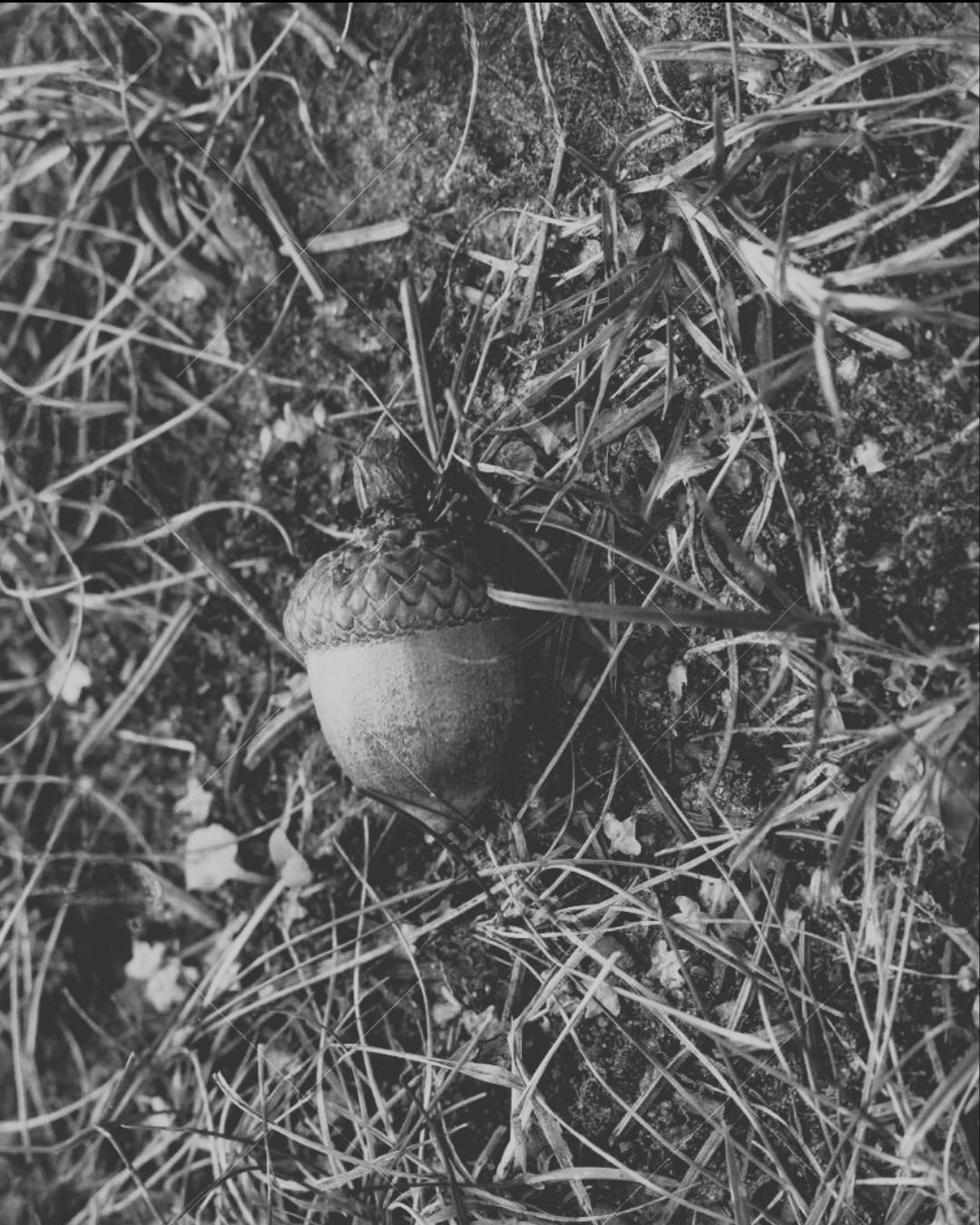
The other day I was walking in new woods and I looked down at an opportune time to observe an acorn. An acorn is no longer a seed, but not yet an oak.
Aristotle used the acorn and oak as a classic example of potential becoming actuality: the oak is already “inside” the acorn in essence, even if it has not yet appeared. Underground masked in the darkness of unknowing, the acorn is doing the invisible work required before anything visible can emerge. Such is my world at this time.
Yet there is a particular loneliness in being between forms, in having left one life but not yet embodied in the next version of yourself.
Truthfully, my body is still oriented toward the old. I wake up wet from the vivid dreams of what is no more and I have shed more than an ocean of tears on all that was lost. There are no mountains strong enough to bear the fury of my frustration for not being ‘better by now’. Frankly, I have days where I oscillate from pain to power, from loss to hope, from rage to peace, and back again.
I pour my mind over all I did, all that I could have done and if in any world it could have been different. I find myself resting on the singular truth that yes, it could. It could have been worse.
Amor Fati is a latin phrase that means “love of one’s fate”. This is far beyond the mere acceptance or resignation of what is but the deliberate wanting of it. It is the perspective of loving our fate as necessary to who we are. It is the full investment into our life, exactly as it is, no revisions.
In real time this might look like embracing the impact as more than just an opportunity to grow and improve but also with joy and gratitude that this too, is an essential part of our becoming.
Amor fati is more than just an attitude, it is an orientation to which we align ourselves in celebration of a life gladly lived exactly as it is, over and over again.
As I reflect on this, I am struck with a beautiful realization. The immensity to which I am experiencing my grief is in proportion to which I have experienced its joy. The depths I know now are only made possible by the peaks which preceded them.
Newton’s Third Law states that for every action, there is an equal and opposite reaction. Whenever one object exerts a force on a second object, the second object simultaneously exerts a force of equal magnitude and opposite direction back on the first. These force pairs always act on different objects.
All I loved and all I lost are not separate but of the same force, observed from two different moments in time.
How lucky am I to have known something so great and true and real that I notice its absence so profoundly and painfully?
How brave I have been to subject myself to love so deep and complete that its absence now instructs me in the full dimension of what I am capable of feeling?
The very fact that I could be moved to such heights of love and appreciation means I am capable of great range, where these depths but confirm that it was in fact, real.
And where in my life, as it exists right now, is the goodness that I will someday mourn, too? That’s what I need to notice and give life to, while I still can.
Most people live a life close to the middle. Compressing peaks and valleys into the same flatline existence. Why? Because loss hurts. But in every loss lingers the energetic potentiality for equal and opposite, if not often greater, joy and love again.
I want that.
Here I find myself, in all the wreckage and rubble, uncovering a more persistent truth that is sincerely my own.
So much of our lives we live under the burdens of what we think the world expects from us. What is ‘good’ and ‘just’ and ‘admirable.’ I find myself in a strange space of freedom. Unshackled and unbothered how it all appears to someone on the outside. For how can I possibly bring consciousness to the loose and tainted opinions of anyone who has not lived a moment in my mind?
I can only afford to give energy to what is my own. To rebuild deliberately, with discipline and through resistance, knowing everything I endured and experienced and alchemized before this brought me here: to the knowledge that I can transmute stress into capacity.
There is no benefit to adding more demands of myself, or timelines or ideals about what I should do. I have painfully discarded such false narratives of meaning or expectation.
What’s left is the simple and honest experience of the self, as it is right now.
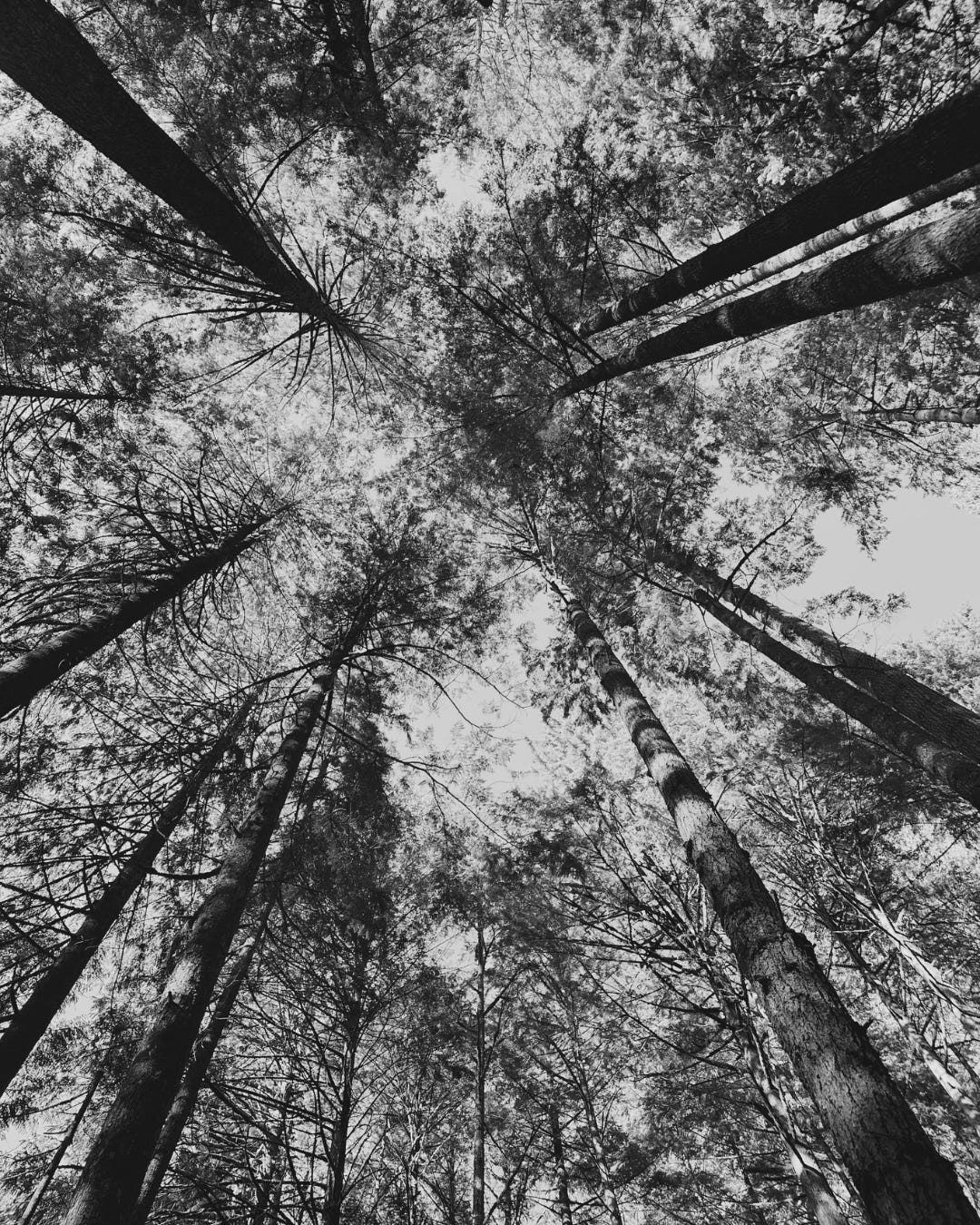
As I am now, I am someone who misses her trees. The comforting, sometimes eerie energy of being among an army of quiet giants that have been there before you and will be there long after you are gone. Many times among their formidable presence have I found myself screaming or laughing or prostrating at their thick trunks imploring them to impart me with their wisdom and strength.
Every so often a great storm arrives with its roaring and violent winds beating mercilessly upon the branches of the defenseless forest. Here, the trees do something quiet phenomenal. They sway with the incessant wind.
The roots hold, like springs; the memory, the identity, the return to form.
The trunk and branches yield like the dashpot; the dissipation, the managed movement, the bleeding off of force.
The trees that survive even the most malicious storms do not snap or uproot. The trees that remain are the ones that bend without breaking.
I am fortified by my memories of watching the great giants sway and reminded that the storm is never the end of the story, but a necessary chapter in the fortification of the forest as a whole.
The storm will claim some trees and in their destruction, light reaches new places for new seeds to grow. The trees that fall decompose and support new life and the roots, a vast mycorrhizal network of underground communication for the whole forest, observes it all and adjusts its wisdom for future storms and growth alike.
The Buddhists have an idea about the self known as Anatta. It says there is no fixed thing at the center of you, which is both unsettling and liberating.
They believe that form, sensation, perception, mental formations, consciousness all arise together to create the experience of a self. But none of them individually is you, and the collection of them has no permanent owner.
At first this feels a little uncomfortable until it suddenly feels very familiar. Aren’t we all endlessly searching for our own centre, only to accept the perplexing nature of its complete mystery?
For me, this lands much more true about who we are, and surely about where and as I find myself now.
A process. Not a place.
There is continuity in the imprecise centre. Shock absorption is proof of this. There is no rigid core that can crack, because there was never a rigid core to begin with. Everything is energy transmuting from one form to another.
Our job then is not to resist it or contain it but rather to absorb with the full force of its impact and allow it to carry on as a ripple of energetic experience that makes us exactly who we are.
Amor fati, indeed.
In addition to my passion for writing, I am a voracious reader of classic literature but I confess I came to Dickens reluctantly. It was not a flavor of literature I had ever found particularly appealing and I had resisted it in a series of failed attempts and restarts longer than I might admit.
In my current space of non-form, however, the title, Great Expectations became increasingly irresistible.
To my usual form, I found the start quite a slog, but eventually, the clever plot twists and turns delighted and engaged me wholly, reminding me that life, much like the book is full of no end of serendipitous surprises, if we stay open to living them.
I turned the final page of Great Expectations on the same day that I found the acorn, and the parallels felt profound. The unraveling of the belief that if I become this, then I will finally be enough to belong, to have, to be what I think is expected of me.
Pip spends the entirety of his story chasing a version of himself he believes will finally be enough. He exhausts himself becoming someone else’s idea of who he should be, only to discover that he belonged most fully to himself exactly as he began. In confirmation, the acorn does not strive to become the oak. It either does or it doesn’t, but in the meantime, it’s an acorn of its own measure.
The acorn, Pip, and I need only carry our potential until the conditions are met to realize it, and that is surely enough in itself.
This day, heavy in its symbolism, reminds me not to rush toward an imagined version of myself, but to honor what is present in this space, now.
We have been speaking of impact as force to be survived, but there is also the resonant complement, the opposite and equal impact of beauty, of art, of a story or an acorn that finds you exactly when you need it.
These too are energetic transmissions. These too change the structure of what receives them.
Perhaps this is the whole point: we build our capacity to absorb the hard impacts not only through resilience and rest and robustness, but also through intentionally and deliberately seeking the kind of impact that invites us to stay open to the wonder of life itself.
So on an ordinary Sunday did I settle, neither to oscillation nor dissipation, but an enduring ripple, ever in process, prepared for anything, expecting nothing, being everything; whole, as I am.
Such marks the end of my great expectations. And the beginning of my great experiences.
𓇗 As an acorn of my own measure, becoming alongside you — SJT